GEO

GEO: The New Frontier of SEO That Is Transforming Digital Marketing

Raquel GIMENO
The SEO landscape is undergoing its most significant transformation since the advent of artificial intelligence algorithms. While companies are still adapting to Google’s updates, a new discipline is quietly emerging: Generative Engine Optimization (GEO). This evolution does not represent the end of traditional SEO, but rather its expansion into an ecosystem where generative artificial intelligence becomes the new intermediary between brands and their audiences.
The reality is that millions of users already consult ChatGPT, Claude, Gemini, and other AI systems daily to get recommendations, resolve complex questions, and make purchasing decisions. When an executive asks an AI what the best CRM software is for their company, or when a consumer seeks investment advice, these platforms are generating responses that may include or exclude your brand from the most important conversation: the one that leads directly to the purchase decision.
In this in-depth analysis, we will explore exactly what GEO is, how it is redefining organic positioning strategies, and why companies that fail to adapt to this new reality could fall behind in an increasingly competitive market. You will discover the practical implications of this evolution and how to prepare your digital strategy for the future of online marketing.
The reality is that millions of users already consult ChatGPT, Claude, Gemini, and other AI systems daily to get recommendations, resolve complex questions, and make purchasing decisions. When an executive asks an AI what the best CRM software is for their company, or when a consumer seeks investment advice, these platforms are generating responses that may include or exclude your brand from the most important conversation: the one that leads directly to the purchase decision.
In this in-depth analysis, we will explore exactly what GEO is, how it is redefining organic positioning strategies, and why companies that fail to adapt to this new reality could fall behind in an increasingly competitive market. You will discover the practical implications of this evolution and how to prepare your digital strategy for the future of online marketing.
What is GEO (Generative Engine Optimization)?
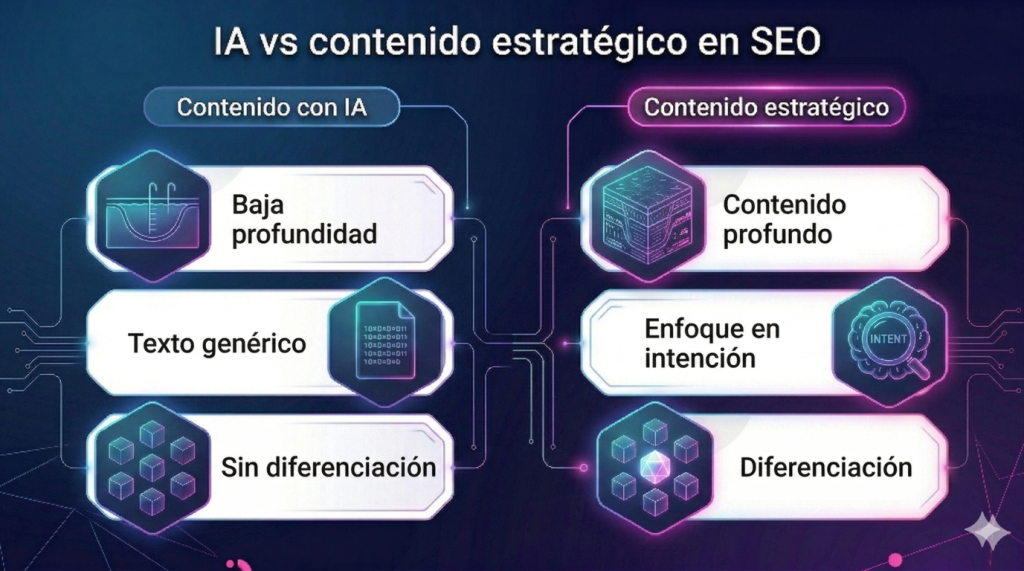
Generative Engine Optimization, or GEO, represents a paradigm shift in how we understand digital optimization. While traditional SEO has focused for decades on positioning content so that Google’s algorithms display it in search results, GEO focuses on something fundamentally different: being the source of information that artificial intelligence cites, recommends, and uses to generate its responses.
This distinction is crucial because it completely changes the nature of digital competition. In traditional SEO, we compete to appear on the first page of Google results. In GEO, we compete to be the voice that speaks through artificial intelligence when it responds to specific queries in our industry.
The Transformation of User Behavior
To understand the importance of GEO, it is essential to recognize how search behavior has evolved. Users no longer just type “best digital marketing tools” into Google and browse through multiple links. Now they ask complex conversational questions such as “I need a digital marketing tool that integrates email marketing, automation, and CRM for a 50-employee company in the real estate sector, with a budget of $500 per month.”
This query, which is impossible to satisfy effectively with traditional SEO, finds an immediate and personalized response through generative engines. AI not only provides options, but also contextualizes, compares, and recommends based on the specific parameters provided by the user.
Main differences between SEO and GEO:
- Traditional SEO optimizes for search engine rankings, GEO optimizes for being cited by AIs.
- SEO seeks clicks, GEO seeks mentions. SEO depends on backlinks, GEO values accuracy and context of the content provided to artificial intelligence.
Fundamental Differences in Approach
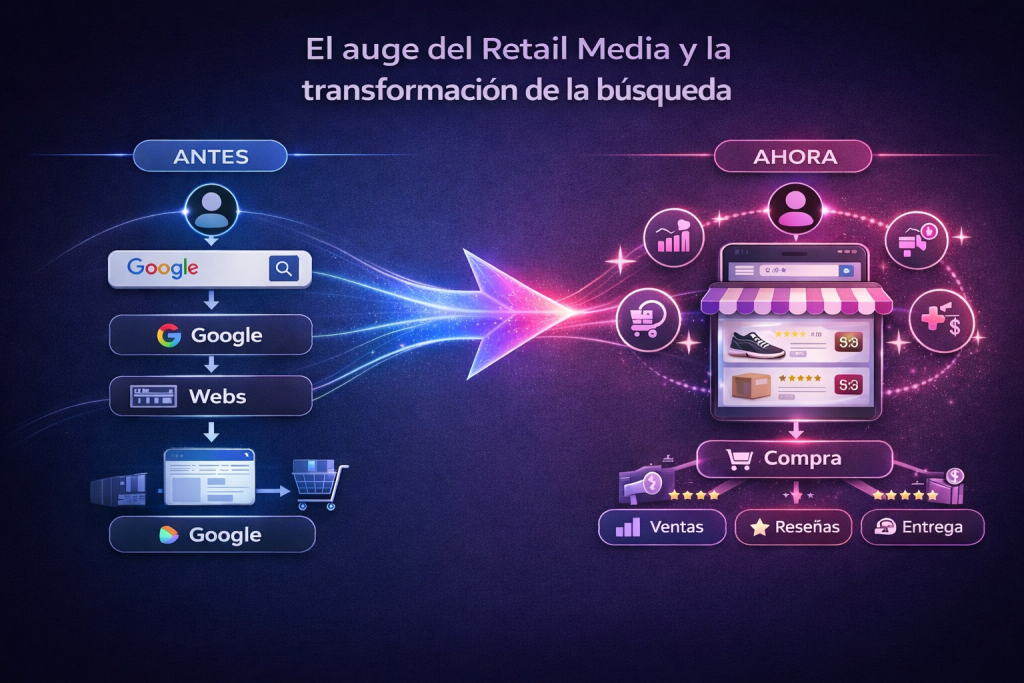
Traditional SEO operates under the premise that the user will navigate from the search results to our content. GEO, on the other hand, assumes that the answer will be consumed directly in the AI interface, and our goal is to influence that answer by being quoted, mentioned, or recommended within it.
This difference has profound implications for content strategy. Instead of optimizing to attract clicks, we optimize to be the authoritative source that AI considers most reliable and relevant to include in its responses. This requires a completely different approach in terms of content structure, informational depth, and establishing thematic authority.
The Generative Engine Ecosystem: Beyond ChatGPT
The ecosystem of generative artificial intelligence has rapidly evolved from a technological niche to become mainstream tools that millions of professionals use every day. OpenAI’s ChatGPT, with over 180 million active users, has been the catalyst for this revolution, but the current landscape is much more diverse and complex.
Google Gemini represents perhaps the most significant development for the future of GEO, given that it is directly integrated into the world’s most widely used search ecosystem. Google’s Search Generative Experience (SGE) is already displaying AI-generated answers at the top of traditional search results, creating a hybrid between classic search and generative response that defines the future of digital discovery.
Microsoft Copilot, deeply integrated into Office 365 and Microsoft’s enterprise ecosystem, is transforming how professionals search for and process information in corporate environments. When an executive consults Copilot about marketing strategies for the next quarter, the recommendations they receive can influence budget decisions worth thousands or millions of euros.
Claude from Anthropic has found its niche in long conversations and complex document analysis, becoming the tool of choice for professionals who need to process large volumes of technical information. Its ability to maintain context in lengthy conversations makes it particularly valuable for consulting and strategic decision-making.
The Inevitable Convergence
What we are witnessing is not competition between separate systems, but convergence toward an interconnected ecosystem where artificial intelligence collaborates with traditional search engines. Google already implements AI Overviews that appear before traditional organic results, displaying AI-generated answers that synthesize information from multiple sources.
This convergence means that the future of SEO will not be a choice between traditional optimization or GEO, but rather the need to master both disciplines simultaneously. Companies that understand this duality will have a substantial competitive advantage in the coming years.
How Optimization for Generative Engines Works
The mechanics of GEO differ fundamentally from traditional SEO in several critical ways. While search algorithms evaluate relevance based on signals such as backlinks, dwell time, and technical optimization, generative engines operate with more sophisticated and contextual evaluation criteria.
Content Authority in the Age of AI
Artificial intelligence systems have developed sophisticated mechanisms for evaluating the authority and credibility of sources. Unlike traditional algorithms that rely heavily on external signals such as inbound links, AIs can directly analyze the quality, consistency, and accuracy of content.
This means that authority in GEO is built differently. A source can have authority for an AI without necessarily having thousands of backlinks, if it consistently demonstrates accurate, up-to-date, and well-founded information. AIs especially value sources that provide context, explain methodologies, and cite verifiable references.
For example, when an AI evaluates content on digital marketing strategies, it considers not only how many sites link to that content, but also the depth of the analysis, the timeliness of the data presented, consistency with recognized authoritative sources, and the content’s ability to provide unique and valuable insights.
Semantic Structure and Contextual Understanding
Generative engines have superior semantic understanding compared to traditional search algorithms. They can identify complex relationships between concepts, understand causal implications, and contextualize information within specific temporal and situational frameworks.
This superior capability requires GEO-optimized content to be structured in a more sophisticated manner. It is not enough to include keywords naturally; content must demonstrate a deep understanding of the relationships between concepts, provide historical context when relevant, and establish clear connections between cause and effect.
When developing content for generative optimization, we must think like educators rather than optimizers. The goal is to provide AI with the most complete and contextualized information possible on a topic, enabling it to generate more accurate and valuable responses for end users.
Response Format and Information Extraction
Artificial intelligence has specific preferences for how information should be structured to facilitate its extraction and use in generative responses. This does not simply mean using numbered lists or bullet points, but rather organizing information in a way that allows AI to extract specific insights based on the context of each query.
GEO-optimized content should anticipate multiple types of queries and provide structured information that can be used in different ways. For example, an article on digital marketing tools should include not only descriptions of features, but also context on when to use each tool, detailed comparisons, budget considerations, and specific use cases by industry.
The Impact of GEO on Digital Marketing Strategies
The adoption of GEO is fundamentally transforming how companies approach their digital presence and content strategy. This transformation goes beyond simply adding a new tactic to the marketing mix; it requires completely rethinking how we create value for our audiences in a world where immediate, contextualized responses are becoming the norm.
Transformation in the B2B Sector
The impact of GEO is particularly pronounced in the B2B sector, where decision makers face complex decisions that require detailed analysis of multiple variables. Traditionally, a technology director looking to implement a new CRM solution might spend weeks researching options, comparing features, and evaluating vendors.
In the new paradigm, that same executive can consult artificial intelligence with a specific question such as “I need a CRM that integrates with our current technology stack, manages geographically distributed sales teams, and has advanced reporting capabilities for a 200-employee company in the financial sector.” AI can provide specific recommendations, detailed comparisons, and even suggest implementation processes.
This transformation means that B2B companies must optimize not only to be found, but to be recommended in specific contexts. This requires developing content that addresses particular scenarios, detailed use cases, and providing information that allows AIs to make informed and contextualized recommendations.
The Evolution of Marketing Agencies
Marketing agencies are undergoing a significant transformation in their service offerings to adapt to the GEO paradigm. It is no longer enough to offer traditional SEO services; leading agencies are developing new specialized skills in optimization for generative engines.
This includes services such as AI response visibility audits, where agencies assess how often and in what contexts their clients’ brands are mentioned by different artificial intelligence systems. They are also developing content strategies specifically designed to be cited by AIs, which requires a deep understanding of how these systems evaluate and select sources.
The most innovative agencies are implementing monitoring systems that track brand mentions in generative responses, analyze the sentiment and context of these mentions, and develop strategies to improve their clients’ representation in the artificial intelligence ecosystem.
Redefining Metrics and KPIs
GEO is forcing companies to rethink how they measure success in digital marketing. Traditional metrics such as SERP rankings, organic traffic, and CTR, while still relevant, do not fully capture the value generated by a strong presence in generative responses.
New metrics include frequency of mentions in AI responses, quality of the context in which the brand is mentioned, and accuracy of the information that AIs provide about the company. These metrics require new measurement tools and analysis methodologies that many companies are still developing.
Tools and Techniques for Implementing GEO
Effective implementation of GEO requires a systematic approach that combines new monitoring tools with optimization techniques specifically designed for generative engines. Unlike traditional SEO, where we have decades of mature tools and established methodologies, GEO is in its early stages, which means that many companies are developing their own internal processes and tools.
Monitoring System Development
Effective GEO monitoring requires a more manual and qualitative approach than traditional SEO. While we can use automated tools to track rankings and traffic in SEO, monitoring mentions in generative responses requires regular queries to multiple AI systems with different types of questions related to our industry and brand.
More sophisticated companies are developing monitoring protocols that include regular queries to ChatGPT, Claude, Gemini, and other systems with questions ranging from general industry inquiries to specific questions about product comparisons and recommendations. This process requires documenting not only whether the brand is mentioned, but also the context of the mention, the relative position compared to competitors, and the accuracy of the information provided.
Some companies are experimenting with APIs from different AI systems to partially automate this process, although the conversational and contextual nature of generative responses means that qualitative analysis remains essential.
Specific Content Strategies for GEO
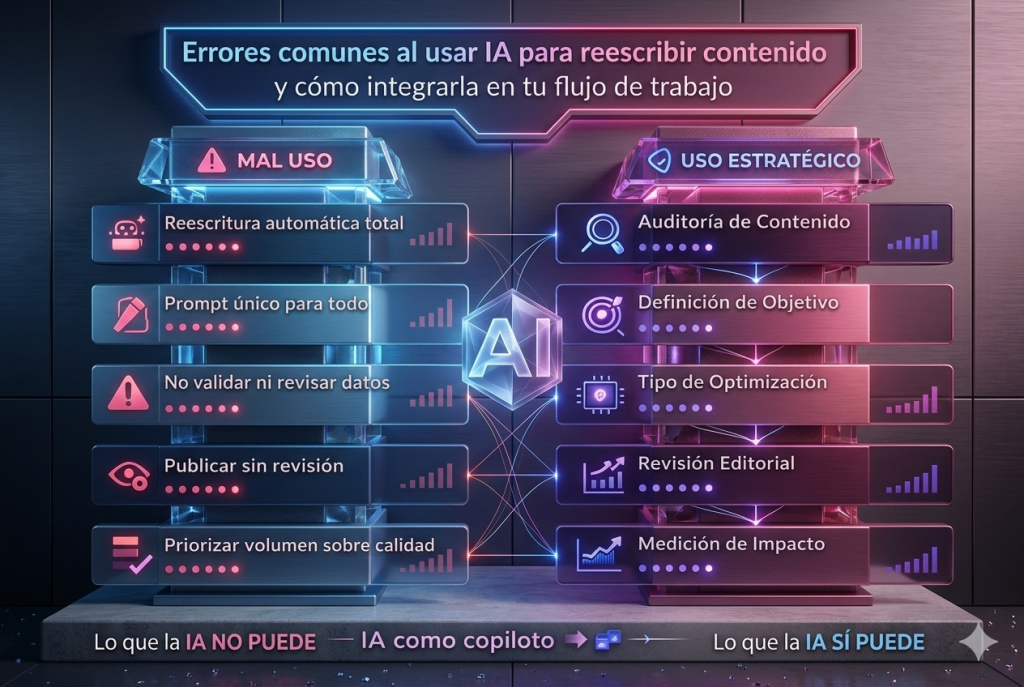
Developing content for GEO requires a fundamentally different approach than traditional SEO content. Rather than optimizing primarily for keywords and search phrases, content for generative engines should be optimized to answer complex questions and provide comprehensive context that enables AIs to generate useful and accurate responses.
The most effective content for GEO tends to be deeply educational, with clear explanations of complex concepts, historical context when relevant, and explicit connections between different ideas and concepts. AIs particularly value content that not only presents information, but also explains the “why” behind recommendations and conclusions.
For example, rather than simply listing the features of a software product, GEO-optimized content would explain when and why to use each feature, what problems it solves, how it compares to alternative approaches, and what considerations users should take into account when implementing the solution.
Technical Optimization for Generative Engines
Technical optimization for GEO focuses less on traditional factors such as loading speed and more on data structuring and information accessibility. Generative engines need to be able to access, understand, and extract information from our content efficiently.
This includes implementing more detailed schema markup that helps AIs understand the context and relationships between different pieces of information. It also requires structuring content in a way that makes it easy for AIs to extract specific information based on the context of each query.
The most advanced companies are experimenting with content formats specifically designed for generative optimization, including data structures that facilitate the extraction of contextual information and rich metadata that provides additional context about the authority and timeliness of the content.
The Future of SEO: Integration and Evolution
The future landscape of digital marketing will be fundamentally hybrid, combining traditional SEO strategies with advanced GEO techniques in an integrated ecosystem where both disciplines complement and reinforce each other. This integration is not optional; it is imperative to remain competitive in a market where consumers expect immediate, accurate, and contextualized responses.
According to Search Engine Land, it is estimated that by 2026, more than 40% of search queries will include some element of artificial intelligence processing, underscoring the critical importance of developing GEO skills alongside traditional SEO.
Frequently Asked Questions about GEO
Will GEO replace traditional SEO?
No, GEO complements traditional SEO rather than replacing it. Businesses will need hybrid strategies that optimize for both search engines and generative engines. Traditional search will remain relevant, especially for transactional and navigational queries, while GEO will be crucial for complex informational queries and contextualized recommendations.
How long does it take to see results in GEO?
GEO results can be more immediate than traditional SEO, as artificial intelligence can begin citing new content within days or weeks. However, establishing consistent authority in generative responses requires 3-6 months of optimization for consistent AI and high-quality content development.
Do I need specific content for GEO?
While you can optimize existing content for GEO, creating content specifically designed for conversational queries and generative responses produces better results. This content should be more direct, factual, and structured than traditional SEO content, with an emphasis on providing comprehensive context and complete answers to complex questions.
Conclusion: SEO Evolves, It Doesn’t Disappear
Generative Engine Optimization does not represent the obsolescence of traditional SEO, but rather its natural evolution toward a more complex and sophisticated ecosystem where multiple channels and technologies converge to create richer and more contextual user experiences. Companies that understand this convergence and adapt their strategies accordingly will have significant competitive advantages in the coming years.
The transition to a hybrid SEO/GEO model requires more than simply learning new techniques; it requires a fundamental shift in how we think about content creation, audience engagement, and value delivery. Instead of creating content primarily to attract clicks, we must create content that genuinely educates, informs, and empowers users to make better decisions.
This evolution also represents an opportunity to raise the quality of digital marketing in general. GEO rewards companies that provide genuine value, accurate information, and thoughtful analysis over those that simply optimize to manipulate algorithms. In many ways, GEO brings us back to the fundamental principles of good marketing: understanding your audience, providing real value, and building genuine trust and authority.
The future of digital marketing will be defined by companies that can successfully navigate both traditional search optimization and optimization for generative engines simultaneously. This requires new skills, new processes, and new ways of measuring success, but it also creates unprecedented opportunities for companies willing to invest in this evolution.
The time to start experimenting with GEO is now. As generative AI systems become more sophisticated and widely adopted, companies that establish a strong presence early on will have significant advantages over those that wait to see how the landscape develops.