AI

From Google to ChatGPT: How are search patterns and SEO changing?

Raquel GIMENO

Search engines are undergoing the most radical transformation in their history. What began as simple algorithms that indexed web pages has evolved into complex artificial intelligence systems capable of understanding context, generating original responses, and holding natural conversations with users. This evolution is not just a technical improvement; it represents a fundamental change in how people discover information and make decisions online.
AI-powered search is no longer a futuristic promise, but a present reality that is redefining the rules of the digital game. Google processes more than 8.5 billion searches daily, and more and more of these queries are receiving answers generated by artificial intelligence. Microsoft has integrated ChatGPT into Bing, completely transforming the traditional search experience. OpenAI has launched SearchGPT, directly challenging Google’s monopoly.
We believe we are witnessing the dawn of a new era in digital search, where the line between traditional search engines and intelligent assistants is blurring to the point of disappearing. In this in-depth analysis, we will explore how artificial intelligence is transforming search engines, what this evolution means for businesses and professionals in digital marketing, and how to adapt to an ecosystem where direct answers are gradually replacing lists of links.
AI-powered search is no longer a futuristic promise, but a present reality that is redefining the rules of the digital game. Google processes more than 8.5 billion searches daily, and more and more of these queries are receiving answers generated by artificial intelligence. Microsoft has integrated ChatGPT into Bing, completely transforming the traditional search experience. OpenAI has launched SearchGPT, directly challenging Google’s monopoly.
We believe we are witnessing the dawn of a new era in digital search, where the line between traditional search engines and intelligent assistants is blurring to the point of disappearing. In this in-depth analysis, we will explore how artificial intelligence is transforming search engines, what this evolution means for businesses and professionals in digital marketing, and how to adapt to an ecosystem where direct answers are gradually replacing lists of links.
The Evolution of Search: From PageRank to Artificial Intelligence
To understand the magnitude of the current transformation, it is essential to review how we got here. Search engines have evolved in distinct technological waves, each marking a qualitative leap in capabilities and user experience.
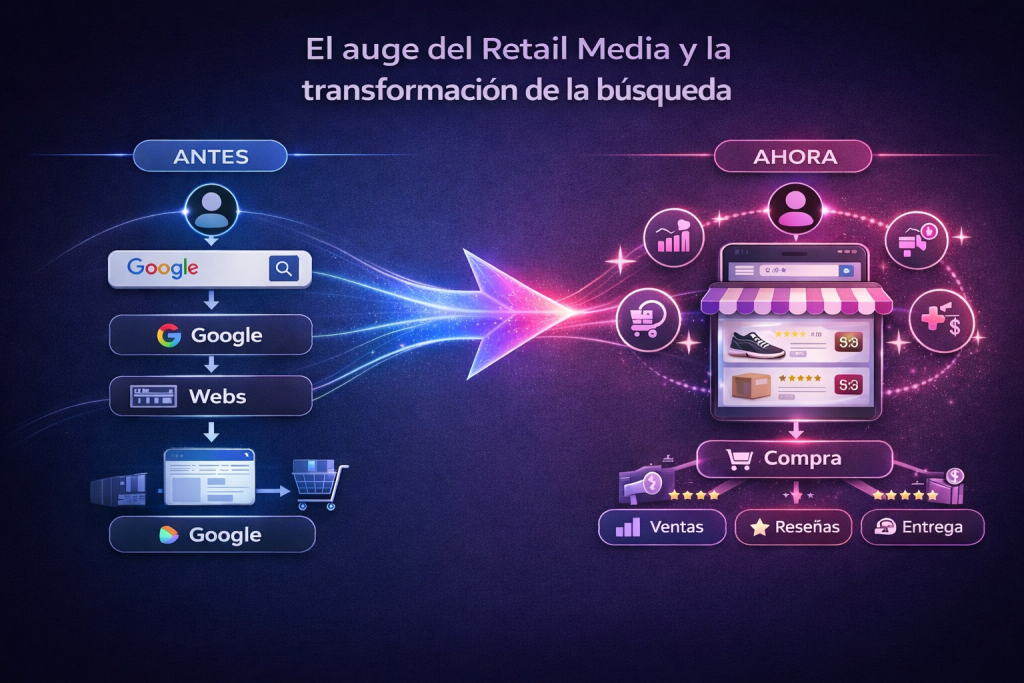
The first era, dominated by Google’s PageRank algorithm, was based on link authority and keyword relevance. Users entered specific search terms and received lists of web pages ranked by relevance. This model worked extraordinarily well for two decades, establishing Google as the gatekeeper of global information access.
The second era introduced semantic understanding with updates such as Hummingbird and RankBrain, where Google began to understand the intent behind queries. Users could ask more natural questions, and the engine could interpret synonyms, context, and relationships between concepts.
Now we are entering the third era: AI-powered search. Engines not only understand queries; they can generate original answers, hold contextual conversations, and provide synthesized information from multiple sources. This capability represents a qualitative leap comparable to that experienced by the web when it moved from static pages to dynamic, interactive content.
The Catalyst: Large Language Models
The current revolution has its origins in the development of Large Language Models (LLMs) such as GPT, BERT, and PaLM. These systems have demonstrated text comprehension and generation capabilities that were unthinkable just five years ago.
Their integration into AI search engines has unlocked possibilities that go far beyond traditional search.
LLMs enable search engines to process complex conversational queries, understand multi-turn context, and generate responses that synthesize information from multiple sources. This capability fundamentally transforms the relationship between user and search engine, from a transactional interaction to a conversational and collaborative experience.
Google and the Search Generative Experience (SGE)
Google, aware that its dominance in search could be threatened by new paradigms in artificial intelligence search, has responded with the Search Generative Experience (SGE). This initiative represents the company’s most ambitious attempt to integrate generative capabilities into its core search engine without cannibalizing its advertising-based business model.
How SGE Works
The Search Generative Experience appears as an expandable panel at the top of traditional search results. When users make complex informational queries, the system generates a synthetic response that combines information from multiple web sources, citing the references used.
This implementation is particularly smart because it maintains the existing ecosystem while introducing generative capabilities. Users can get quick, synthetic answers, but also access the original sources if they want to dig deeper. Websites retain the opportunity to receive traffic, albeit potentially at a lower volume.
We are not entirely sure how SGE will impact organic traffic in the long term, but early observations suggest that informational queries may experience significant reductions in clicks to websites, while commercial and transactional queries maintain more traditional patterns.
Impact on User Experience
AI search engines such as SGE are fundamentally changing user expectations. The current generation, especially younger users, is developing a preference for direct, contextualized answers over lists of links. This preference could accelerate the adoption of conversational interfaces in search.
We believe that SGE represents only the first step in a much broader transformation. Google is likely experimenting with more advanced versions that could include multi-turn conversational capabilities, deep personalization based on user history, and integration with other Google services to provide more contextually relevant answers.
Microsoft Bing: Going All In on Conversational AI
Microsoft has taken a radically different approach with Bing Chat, fully integrating ChatGPT into its search experience. This decision represents a bold commitment to the conversational future of search, positioning Bing not as an enhanced traditional search engine, but as an intelligent assistant that can search for information in real time.
ChatGPT-Bing Integration
The collaboration between Microsoft and OpenAI has resulted in an AI-powered search experience that allows users to have natural conversations while accessing up-to-date information from the web. The system can answer follow-up questions, maintain context across multiple exchanges, and provide answers ranging from simple explanations to complex analysis.
This integration has demonstrated impressive capabilities in specific use cases: complex trip planning, academic research, product comparison, and technical problem solving. Users can ask questions such as “Help me plan a 5-day trip to Japan on a budget of $2,000, considering that I don’t speak Japanese and prefer to avoid crowds.”
Limitations and Challenges
However, Microsoft’s implementation has also revealed significant limitations of current AI search engines. The models can generate incorrect information, display biases in their responses, and occasionally provide inappropriate recommendations. Microsoft has implemented moderation systems and filters, but there is no complete certainty about the long-term effectiveness of these measures.
The experience also consumes significantly more computational resources than traditional search, raising questions about scalability and operating costs. We believe these technical and economic challenges will significantly influence how AI search engines evolve in the coming years.
However, Microsoft’s implementation has also revealed significant limitations of current AI search engines. The models can generate incorrect information, display biases in their responses, and occasionally provide inappropriate recommendations. Microsoft has implemented moderation systems and filters, but there is no complete certainty about the long-term effectiveness of these measures.
The experience also consumes significantly more computational resources than traditional search, raising questions about scalability and operating costs. We believe these technical and economic challenges will significantly influence how AI search engines evolve in the coming years.
OpenAI SearchGPT: The Direct Challenger
The launch of SearchGPT by OpenAI marks a crucial milestone in the evolution of artificial intelligence search. Unlike Google and Microsoft, which have integrated AI into existing engines, OpenAI has built a completely new search experience from scratch, optimized specifically for conversational interactions.
A Completely New Paradigm
SearchGPT completely eliminates the traditional search results interface. There are no lists of links, snippets, or advertisements. Instead, users interact directly with artificial intelligence that can search for information in real time, synthesize answers from multiple sources, and hold contextual conversations on complex topics.
This approach represents the purest vision of what AI-powered search could be: a fully conversational experience where users can explore topics in depth, ask follow-up questions, and receive personalized answers based on the context of the conversation.
Implications for the Web Ecosystem
SearchGPT raises fundamental questions about the future of the web ecosystem. If users can get complete and accurate answers without visiting websites, how will the creation of original content be sustained financially? What incentives will creators have to develop high-quality content if they don’t receive direct traffic?
We don’t have definitive answers to these questions, but we believe that OpenAI and other AI search engine developers will need to find models that compensate content creators in order to maintain the diversity and quality of web content. Some possibilities include direct compensation systems, partnerships with publishers, or subscription models that distribute revenue among creators.
Other Emerging Players: Perplexity, You.com, and Diversification
The initial success of AI search engines has attracted numerous competitors who are experimenting with different approaches to conversational search. Perplexity AI has positioned itself as an “answer engine” that combines web search with cited answer generation. You.com offers a customizable experience where users can choose different sources and response types.
Perplexity: The Academic Approach
Perplexity AI has developed a particularly interesting approach to artificial intelligence search, focusing on providing well-cited and verifiable answers. Its interface clearly displays the sources used for each answer, allowing users to verify the information and explore the original sources.
This approach could be especially valuable for professional and academic uses, where verifiability and accuracy are crucial. We believe Perplexity is setting important standards for transparency in AI search engines, which could influence how larger systems evolve.
You.com: Personalization and User Control
You.com has taken a different approach, allowing users to significantly personalize their search experience. Users can choose which sources to consult, what types of responses to receive, and how the information is presented. This approach recognizes that different users have different search needs and preferences.
Deep personalization could represent a significant competitive advantage in the AI-driven search market. It is unclear whether larger engines will adopt similar levels of personalization, but user demand for control and transparency appears to be growing.
The Underlying Technologies: RAG, Vector Search, and Hybrid Architectures
To fully understand how AI search engines are evolving, it is important to examine the underlying technologies that enable these capabilities. Most current systems use hybrid architectures that combine traditional search with natural language generation.
Retrieval-Augmented Generation (RAG)
RAG technology allows artificial intelligence models to access up-to-date information without the need for complete retraining. The system first searches for relevant information in databases or on the web, then uses that information to generate contextually appropriate responses.
This architecture solves one of the fundamental problems of language models: their knowledge is limited to their training date. With RAG, AI search engines can access up-to-date information and provide responses that reflect recent developments.
Vector Search and Semantic Search
AI search engines use vector representations to understand the semantic meaning of queries and documents. This technology allows relevant information to be found even when there are no exact keyword matches, significantly improving the accuracy of responses.
Vector search also enables capabilities such as conceptual similarity search, where users can find thematically related information without knowing specific technical terms. This capability is particularly valuable for non-expert users searching for information in specialized fields.
Multimodal Architectures
The most advanced AI search engines are beginning to integrate multimodal capabilities, enabling searches that combine text, images, and potentially audio and video. Google has experimented with searches where users can upload an image and ask questions about it, or combine images with text queries.
We believe multimodal capabilities will be fundamental to the next generation of AI-powered search. Users will expect to be able to interact naturally using different types of input depending on the context and their preferences.
The Impact on User Behavior
The adoption of AI search engines is beginning to influence how people search for and consume information. Emerging behavior patterns suggest fundamental changes in user expectations and habits.
More Conversational and Complex Queries
Users of AI-powered search engines are formulating longer, more conversational queries. Instead of using fragmented keywords such as “best small business CRM,” users are typing complete questions such as “What is the best CRM system for a 20-employee retail company that needs e-commerce integration?”
This shift toward more natural queries is changing how companies need to think about content optimization. The focus must shift toward answering specific, complex questions rather than simply including relevant keywords.
Expectations for Immediate and Complete Answers
Users of AI search engines are developing expectations of receiving complete and immediate answers without having to browse multiple websites. This expectation is particularly pronounced among younger users who have grown up with virtual assistants and conversational interfaces.
We are not entirely sure how this trend will affect web content consumption in the long term, but we believe it could accelerate demand for deeper, more authoritative content that provides unique value beyond basic information.
Longer, More Exploratory Search Sessions
The AI search engines are facilitating longer search sessions where users can explore topics in depth through multiple related questions. This capability is particularly valuable for complex research, learning, and decision-making that require consideration of multiple factors.
Exploratory sessions could represent a significant opportunity for companies that can position themselves as authoritative sources in extended conversations on topics within their expertise.
Challenges and Limitations of AI Search Engines
Despite impressive advances, AI search engines face significant challenges that could influence their adoption and evolution. Understanding these limitations is crucial to realistically assessing the future of AI-powered search.
Accuracy and Verifiability of Information
One of the most critical challenges is ensuring the accuracy of the responses generated. Artificial intelligence models can produce information that sounds convincing but is factually incorrect, a phenomenon known as “hallucination.” In search contexts, where users rely on information to make important decisions, accuracy is paramount.
There is no complete certainty about how effective current verification and moderation systems will be in the long term. We believe that the development of better verification mechanisms will be crucial for the mass adoption of AI search engines, especially in professional and academic contexts.
Computational Costs and Scalability
Generating AI responses consumes significantly more resources than traditional search. Each complex query may require intensive processing to find relevant information, synthesize responses, and generate natural text. These costs raise questions about the economic sustainability of offering AI-powered search at scale.
Major providers are investing heavily in model optimization and computational efficiency, but we believe that costs will remain a significant limiting factor in the short term. This could result in differentiated pricing models or limitations on the number of complex queries that users can perform for free.
Biases and Representation
AI search engines can perpetuate or amplify biases present in their training data. This is particularly problematic in sensitive areas such as health, finance, politics, and social justice, where biased responses can have significant consequences.
Developers are implementing moderation systems and specific training to reduce biases, but we are not entirely sure how effective these measures are. We believe that transparency about limitations and biases will be crucial to maintaining user trust.
Opportunities for Businesses and Content Creators
Despite the challenges, the evolution toward AI search engines also creates new opportunities for businesses and content creators who proactively adapt to this new paradigm.
Becoming Authoritative Sources
AI search engines rely on high-quality information sources to generate accurate responses. Companies that can establish themselves as authoritative sources in their fields have the opportunity to be cited frequently in generative responses, potentially reaching wider audiences than with traditional SEO.
This opportunity requires creating exceptionally deep, well-researched, and regularly updated content. Companies must think more like publishers of expertise than keyword optimizers. As we explored in our analysis of GEO (Generative Engine Optimization), strategies for being cited by AIs require fundamentally different approaches than traditional SEO.
Development of Strategic Partnerships
We believe we will see the emergence of direct partnerships between AI search engines and specialized content creators. These agreements could include compensation for content use, preferential access for certain types of queries, or collaboration in the development of specialized responses.
Companies that can demonstrate unique expertise and differentiated value will be better positioned to negotiate these types of partnerships. This could be particularly relevant for highly specialized industries such as medicine, finance, legal, and advanced technology.
Optimization for Conversational Queries
Companies must begin optimizing their content to respond to complex conversational queries rather than fragmented keywords. This includes developing content that addresses specific scenarios, detailed use cases, and natural follow-up questions.
The GEO marketing requires thinking about conversational customer journeys where users can ask multiple related questions in a single session. Companies that can map and respond to these complex journeys will have significant advantages.
The Future of Search: Informed Predictions
Based on current trends and technological developments, we can make some informed predictions about how AI search engines might evolve in the coming years.
Deeper Integration with Digital Ecosystems
We believe AI search engines will integrate more deeply with other digital services. Google could integrate generative search with Gmail, Calendar, and Drive to provide personalized answers based on the user’s personal context. Microsoft could expand the integration between Bing Chat and the Office 365 ecosystem to create smarter productivity experiences.
This integration could result in AI-powered search that understands not only explicit queries, but also implicit context based on the user’s activities, location, calendar, and historical preferences.
Vertical Specialization
It is unclear whether a single AI search engine can be optimal for all types of queries. We believe that specialized engines could emerge for specific verticals: medicine, legal, finance, academic research, e-commerce, etc.
These specialized engines could offer superior capabilities and accuracy in their specific domains, similar to how specialized databases often outperform general solutions for specific use cases.
Evolution towards Proactive Assistants
The AI search engines of the future could evolve into proactive assistants that anticipate information needs based on context and behavior patterns. Instead of waiting for explicit queries, these systems could suggest relevant information, alert users to important developments, and facilitate serendipitous discovery of valuable content.
This evolution would require significant advances in context understanding, predictive modeling, and interface design, but could represent the next generation of artificial intelligence.
Preparing for the Future: Practical Strategies
For companies and professionals in digital marketing, the evolution of AI search engines requires proactive strategic adaptation. We don’t have complete certainty about exactly how this market will develop, but we can identify strategies that are likely to be valuable regardless of the specific path the technology takes.
Invest in Deep Expertise Content
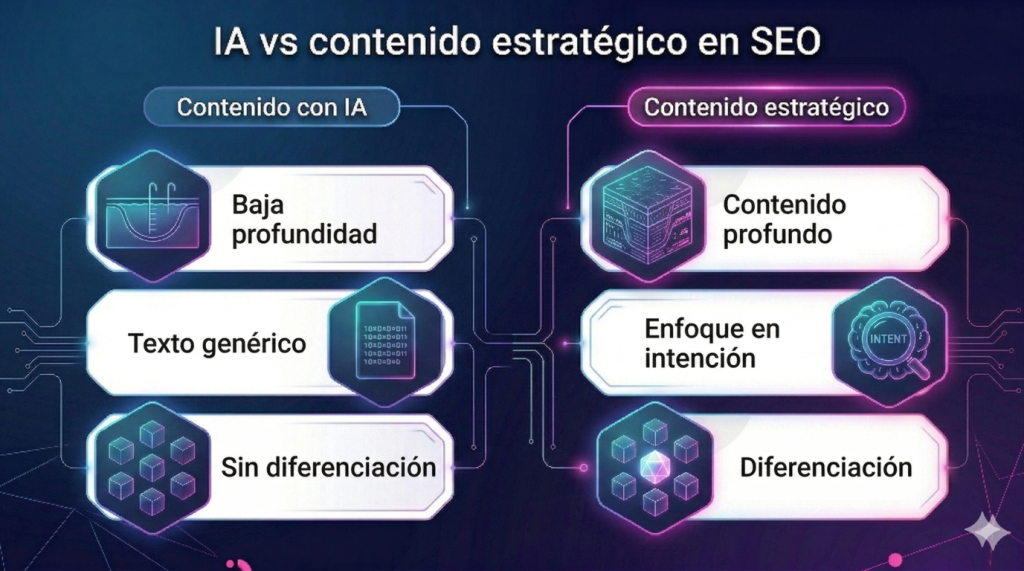
Companies must invest in creating content that demonstrates unique expertise and provides genuine value beyond basic information available from multiple sources. This content must be sufficiently deep and differentiated to be valuable even when synthesized by AI search engines.
This means moving away from content optimized primarily for keywords and toward content that answers complex questions, provides unique insights, and demonstrates genuine thought leadership in areas of expertise.
Developing Monitoring Capabilities
Companies need to develop capabilities to monitor how they are represented in AI-driven search responses. This includes tracking mentions in generative responses, analyzing context and sentiment, and identifying opportunities to improve representation.
These monitoring capabilities are fundamentally different from traditional SEO tools and require more qualitative and manual approaches, at least in the current stages of market development.
Experimenting with Generative Optimization
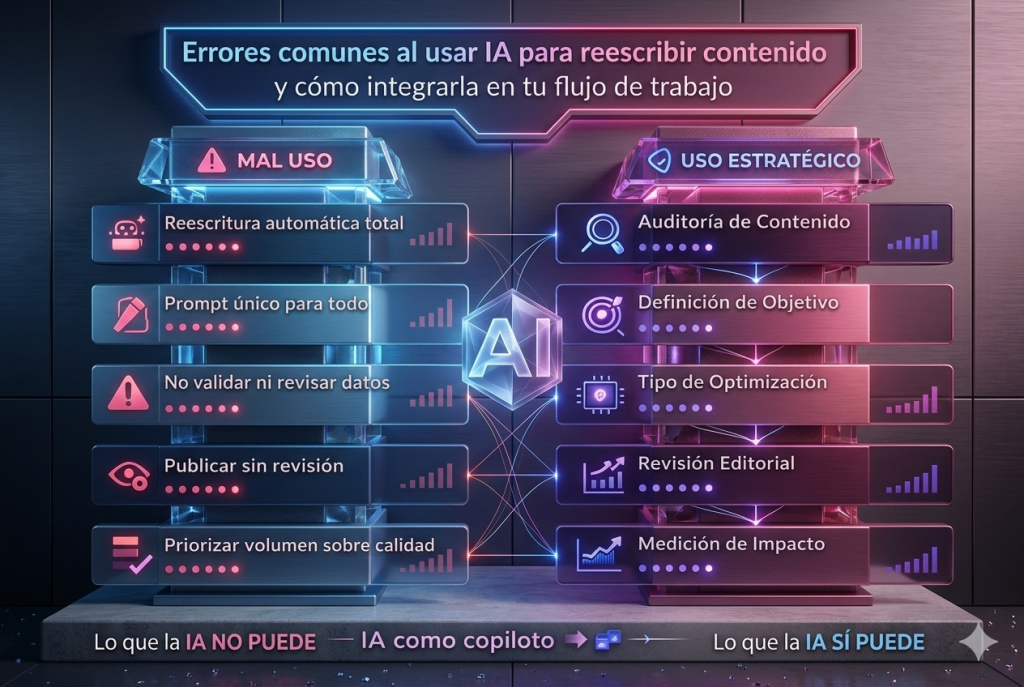
Companies should begin experimenting with optimization techniques specifically designed for AI search engines. This includes structuring content to facilitate extraction by AI systems, developing responses to complex conversational questions, and creating content that can be effectively synthesized with information from other sources.
As we detail in our analysis of GEO, these techniques require different approaches than traditional SEO and benefit from early experimentation and continuous iteration.
Conclusion: Navigating the Search Transformation
AI search engines represent the most significant evolution in digital discovery since the creation of the World Wide Web. This transformation is fundamentally reshaping how people search for information, how businesses connect with audiences, and how knowledge is created and distributed in the digital age.
We believe we are in the early stages of a transition that will unfold over the next 5-10 years. Traditional search engines will not disappear immediately, but they are likely to evolve significantly to incorporate conversational and generative capabilities. Simultaneously, new types of AI-powered search interfaces will emerge for specific use cases and particular audiences.
For businesses, this transformation presents both challenges and opportunities. Those that can proactively adapt, develop high-quality content, and establish genuine authority in their fields will be better positioned to thrive in the new ecosystem. Companies that remain too attached to traditional strategies may find themselves gradually marginalized.
We are not entirely certain about all aspects of how this transformation will unfold, but we firmly believe that artificial intelligence search will be a defining force in the future of digital marketing. Companies that invest in understanding and adapting to these changes will have significant competitive advantages.
The key to success in this new paradigm will be maintaining a focus on providing genuine value to users while adapting to new mechanics of discovery and information distribution. AI search engines reward quality, authority, and genuine usefulness over superficial technical optimization.
Is your company ready for the era of AI-powered search? At SEO Lab, we deeply understand both the opportunities and challenges of this transformation. Our team combines technical expertise in AI marketing with a strategic understanding of how digital ecosystems evolve. We help companies like yours navigate this transition, develop content strategies appropriate for AI search engines, and establish an authoritative presence in the new paradigm of digital discovery. Contact us for a personalized consultation and discover how to position your company for success in the era of artificial intelligence search.