GEO

SEO and AI: How Search Engines Are Evolving Toward 2026

Raquel GIMENO
Search engines are undergoing the most significant transformation since their creation, but contrary to what some people think, this does not mean the end of SEO. The integration of artificial intelligence into SEO represents a fascinating evolution that opens up new opportunities for those who know how to adapt. Google, Microsoft, and other tech giants are redefining how people search for information, and we, as digital marketingprofessionals, have the opportunity to be at the forefront of this revolution. In this article, we will explore how AI is transforming search engines, what it means for the future of SEO, and how you can prepare for what’s coming for SEO in 2026.
The Evolution of Search Engines: From Keywords to Conversations
The New Paradigm: Conversational and Intelligent Search
For more than two decades, search engines operated under a relatively simple model. Users entered specific keywords, the algorithm crawled indexed web pages, and returned a list of results sorted by relevance and authority. This system, while effective, required users to “speak the language” of the search engine.
- Traditional SEO focused on:
- Optimization of specific keywords
- External link building
- Technical structure of the website
- Content oriented towards exact phrases
- Metrics such as keyword density
The New Paradigm: Conversational and Intelligent Search
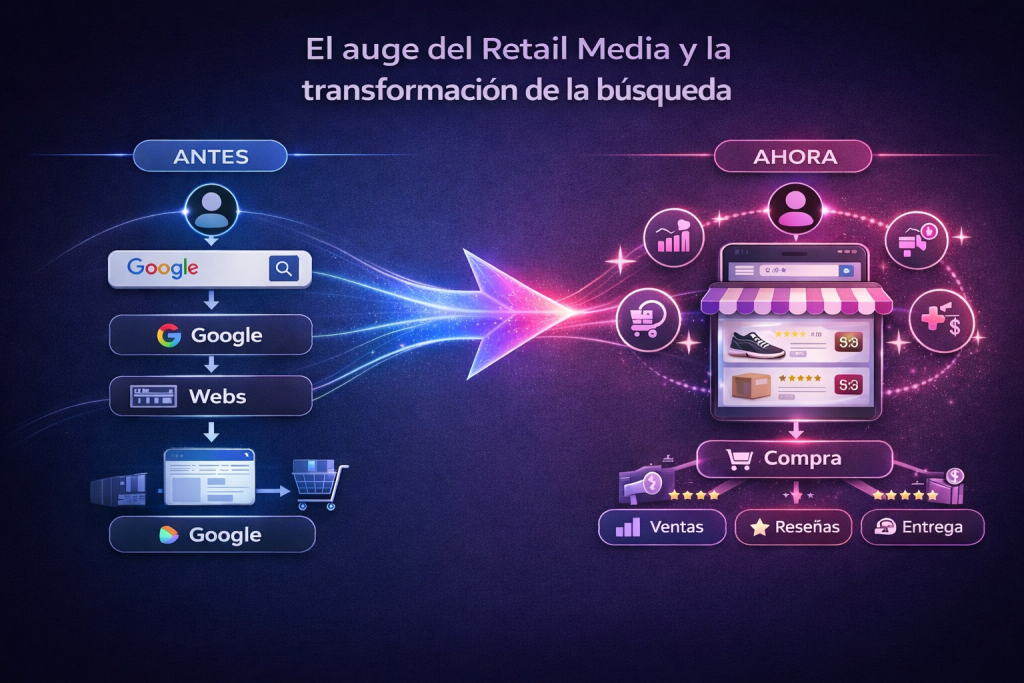
The arrival of artificial intelligence in SEO has revolutionized this landscape. Search engines can now understand context and implicit intentions and hold natural conversations with users. This transformation does not eliminate SEO, but rather makes it more sophisticated and focused on the real user.
Users no longer search for “Italian restaurant Madrid,” but ask “what is the best place for a romantic Italian dinner near me?” This evolution toward conversational search represents a unique opportunity to create more natural and useful content.
The Major Players Driving Change
Google SGE: Search Generative Experience
Google has introduced SGE (Search Generative Experience) as its response to the demand for more intuitive searches. This technology generates conversational responses directly on the results page, using generative AI to synthesize information from multiple sources.
- Key features of SGE:
- Real-time generated responses
- Synthesis from multiple reliable sources
- Maintenance of links to original content
- Improved conversational interface
For SEO professionals, SGE does not represent a threat, but rather an opportunity to appear in these generated responses when our content is truly valuable and well optimized.
ChatGPT and Gemini: The New Competitors
OpenAI with ChatGPT and Google with Gemini have demonstrated the power of conversational AI. These systems not only answer questions, but also maintain context throughout lengthy conversations, generate creative content, and solve complex problems.
- Impact on search behavior:
- Users expect more comprehensive answers
- Demand for contextualized content increases
- Authority and expertise are valued more highly
- The importance of AI optimization grows
Microsoft and the Integration of AI into Bing
Microsoft has made a strong commitment to integrating advanced AI into Bing, creating a more conversational and useful search experience. This commitment has shown that the future of SEO lies in adaptation, not resistance to change.
What This Transformation Means for Current SEO
SEO Is Not Dead, It Has Become More Sophisticated
What we are witnessing is not competition between separate systems, but convergence toward an interconnected ecosystem where artificial intelligence collaborates with traditional search engines. Google already implements AI Overviews that appear before traditional organic results, displaying AI-generated answers that synthesize information from multiple sources.
This convergence means that the future of SEO will not be a choice between traditional optimization or GEO, but rather the need to master both disciplines simultaneously. Companies that understand this duality will have a substantial competitive advantage in the coming years. Contrary to pessimistic predictions, artificial intelligence in SEO has created more opportunities, not fewer. Search engines still need quality content to train their algorithms and deliver accurate answers. The difference is that they can now better evaluate the quality, relevance, and actual usefulness of content.
New emerging ranking factors:
- Demonstrable subject matter authority (E-E-A-T)
- Ability to answer specific questions
- Conversational content structure
- Optimization for snippets and direct answers
- Improved user experience
Changes in Search Intent
AI has enabled search engines to better understand the real intentions behind queries. A search such as “best practices digital marketing 2025” can be interpreted in multiple ways, and now algorithms can deliver more accurate results based on the user’s context.
This evolution requires us to adapt our content strategies to address not only keywords, but entire intents and contexts.
SEO Strategies That Work in the Age of AI
1. Optimization for Conversational Search
The future of SEO lies in understanding how people actually speak and ask questions. This means:
Creating content that answers natural questions:
- How can I improve my SEO with AI?
- What tools do I need for SEO in 2026?
- What are the best optimization methods for AI?
- Implement question-and-answer schemas:
- Structure your content so that it is easily interpretable by AI algorithms. Use FAQ formats, clearly defined sections, and direct answers to common queries.
2. Focus on E-E-A-T (Experience, Expertise, Authoritativeness, Trustworthiness)
AI algorithms are particularly good at evaluating the quality and reliability of content. To stand out in SEO in 2025 and beyond, it is essential to:
- Demonstrate real expertise on the topic covered
- Cite reliable and up-to-date sources
- Maintain consistency in the information presented
- Update content regularly with fresh data
3. Structured and Semantically Rich Content
AI understands context and the relationships between concepts. This means we must create content that:
- Use appropriate schema markup
- Include related entities in a natural way
- Maintain thematic consistency throughout the text
- Connect concepts logically and fluidly
4. Optimization for Snippets and Direct Answers
With the growth of SGE and AI-generated answers, optimizing for snippets becomes crucial:
Key elements for effective snippets:
- Concise answers of 40-60 words
- Clear numbered or bulleted lists
- Precise definitions of technical concepts
- Up-to-date data and statistics with sources
5. Multimodal Content Strategy
AI-powered search engines can process multiple types of content simultaneously. A comprehensive strategy should include:
- Video content optimized with transcripts
- Images with descriptive and contextual alt text
- Audio (podcasts) with rich metadata
- Structured and semantically rich text
The Future: More Opportunities on the Horizon
SEO 2025: Personalization and Intent
SEO 2025 will be characterized by deeper personalization of search results. AI algorithms will be able to consider:
- Personal search history
- Geographic and temporal context
- Content format preferences
- User expertise level
This customization opens up opportunities to create more specific and valuable content for defined audiences.
SEO 2026: Predictive and Proactive Search
Looking ahead to SEO 2026, we can anticipate the development of predictive search, where search engines anticipate information needs before the user even performs the query.
Implications for SEO:
- Greater importance of evergreen content
- Need to anticipate trends and needs
- Optimization for specific moments in the customer journey
- Deeper integration with behavioral data
The Continuous Evolution of the Ecosystem
The search ecosystem will continue to evolve with new players and technologies. The key is to remain adaptable and focused on creating real value for users, regardless of the underlying technology.
Tools and Techniques for AI SEO
AI-Powered Analysis Tools
The market is developing specific tools for AI optimization:
- More sophisticated search intent analysis
- AI-assisted content generation
- Competitor analysis with deeper insights
- Trend prediction based on AI patterns
Monitoring and Optimization Techniques
To remain competitive in this new landscape:
SGE performance monitoring:
Track how your content appears in generated responses and optimize accordingly.
Conversational search analysis:
Use social listening tools to understand how your audience naturally formulates questions.
A/B testing of conversational content:
Experiment with different content formats to see which ones work best with AI algorithms.
Success Stories: Successful Adaptation to SEO with AI
Example 1: E-commerce and Conversational Search
An online technology store adapted its content strategy to include conversational comparisons such as “Which is better, iPhone or Samsung for photography?” Result: 40% increase in qualified organic traffic.
Example 2: B2B Blog and SEO Optimization
A SaaS software company optimized its blog to appear in SGE responses, creating content that answers specific questions about its industry. It managed to appear in 60% of responses generated for key terms in its sector.
FAQ: Frequently Asked Questions about SEO and AI
Will AI completely replace traditional SEO?
No, AI is evolving SEO, not eliminating it. The fundamental principles of creating valuable content and optimizing for users are still relevant, but now they are applied in a more sophisticated way.
Do I need to completely change my SEO strategy?
A radical change is not necessary, but rather a gradual evolution. Keep what works and progressively adapt your strategy to include optimization for AI and conversational search.
What metrics should I monitor in AI SEO?
In addition to traditional metrics, focus on: appearances in generated responses, engagement with conversational content, response rate to specific questions, and quality of traffic generated by AI searches.
When should I start optimizing for AI?
The ideal time is now. Although some technologies such as SGE are still being implemented globally, starting optimization early will give you a competitive advantage when these technologies become widespread.
Does AI-generated content affect my SEO?
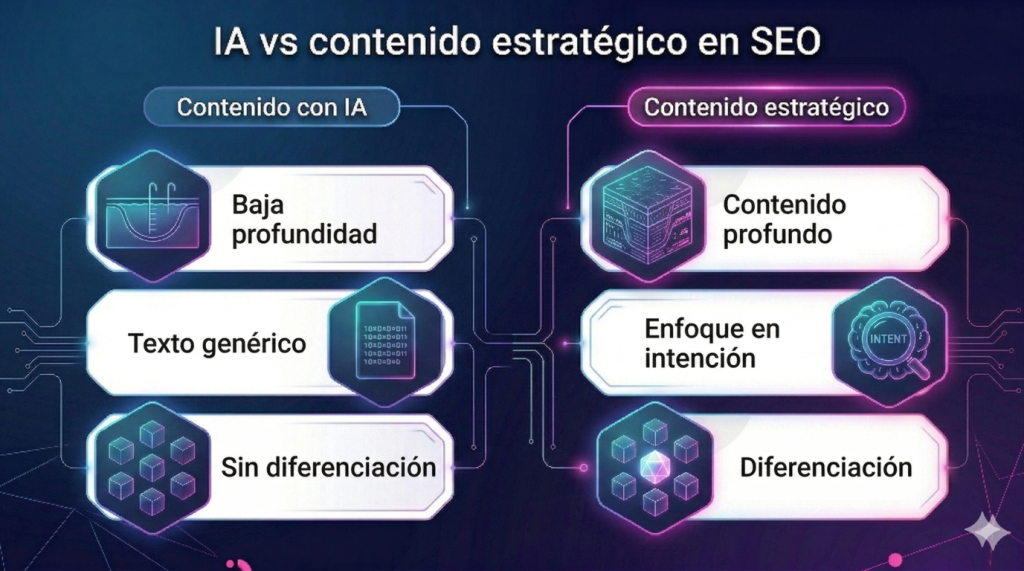
AI-generated content can be useful as a starting point, but it must be reviewed, customized, and enriched with real human expertise to be effective for SEO. AI algorithms are getting better at detecting purely generative content.
Conclusion: SEO Evolves, It Doesn’t Disappear
The transformation of search engines with artificial intelligence represents one of the most exciting opportunities in the history of digital marketing. Far from being the end of SEO, we are witnessing its evolution into a more sophisticated, user-centered, and technically advanced discipline.
The future of SEO is bright for those who embrace change and focus on creating real value. Artificial intelligence in SEO is not here to replace us, but to help us create better experiences for users and more accurate search results.
The opportunities in SEO 2025 and SEO 2026 will be even greater for those who prepare today. The key is to maintain a growth mindset, experiment with new techniques, and, above all, never lose sight of the fact that the main goal is to serve real users with valuable information and exceptional experiences.
Are you ready to evolve your SEO strategy and take advantage of the opportunities offered by the age of AI? At SEOLab Digital, we are here to accompany you in this transformation. Contact us and discover how we can help you position your brand in the future of digital search.
Transformation in the B2B Sector
The impact of GEO is particularly pronounced in the B2B sector, where decision makers face complex decisions that require detailed analysis of multiple variables. Traditionally, a technology director looking to implement a new CRM solution might spend weeks researching options, comparing features, and evaluating vendors.
In the new paradigm, that same executive can consult artificial intelligence with a specific question such as “I need a CRM that integrates with our current technology stack, manages geographically distributed sales teams, and has advanced reporting capabilities for a 200-employee company in the financial sector.” AI can provide specific recommendations, detailed comparisons, and even suggest implementation processes.
This transformation means that B2B companies must optimize not only to be found, but to be recommended in specific contexts. This requires developing content that addresses particular scenarios, detailed use cases, and providing information that allows AIs to make informed and contextualized recommendations.
The Evolution of Marketing Agencies
Marketing agencies are undergoing a significant transformation in their service offerings to adapt to the GEO paradigm. It is no longer enough to offer traditional SEO services; leading agencies are developing new specialized skills in optimization for generative engines.
This includes services such as AI response visibility audits, where agencies assess how often and in what contexts their clients’ brands are mentioned by different artificial intelligence systems. They are also developing content strategies specifically designed to be cited by AIs, which requires a deep understanding of how these systems evaluate and select sources.
The most innovative agencies are implementing monitoring systems that track brand mentions in generative responses, analyze the sentiment and context of these mentions, and develop strategies to improve their clients’ representation in the artificial intelligence ecosystem.
Redefining Metrics and KPIs
GEO is forcing companies to rethink how they measure success in digital marketing. Traditional metrics such as SERP rankings, organic traffic, and CTR, while still relevant, do not fully capture the value generated by a strong presence in generative responses.
New metrics include frequency of mentions in AI responses, quality of the context in which the brand is mentioned, and accuracy of the information that AIs provide about the company. These metrics require new measurement tools and analysis methodologies that many companies are still developing.
Tools and Techniques for Implementing GEO
Effective GEO implementation requires a systematic approach that combines new monitoring tools with optimization techniques specifically designed for generative engines. Unlike traditional SEO, where we have decades of mature tools and established methodologies, GEO is in its early stages, which means that many companies are developing their own internal processes and tools.
Monitoring System Development
Effective GEO monitoring requires a more manual and qualitative approach than traditional SEO. While we can use automated tools to track rankings and traffic in SEO, monitoring mentions in generative responses requires regular queries to multiple AI systems with different types of questions related to our industry and brand.
More sophisticated companies are developing monitoring protocols that include regular queries to ChatGPT, Claude, Gemini, and other systems with questions ranging from general industry inquiries to specific questions about product comparisons and recommendations. This process requires documenting not only whether the brand is mentioned, but also the context of the mention, the relative position compared to competitors, and the accuracy of the information provided.
Some companies are experimenting with APIs from different AI systems to partially automate this process, although the conversational and contextual nature of generative responses means that qualitative analysis remains essential.
Specific Content Strategies for GEO
Developing content for GEO requires a fundamentally different approach than traditional SEO content. Rather than optimizing primarily for keywords and search phrases, content for generative engines should be optimized to answer complex questions and provide comprehensive context that enables AIs to generate useful and accurate responses.
The most effective content for GEO tends to be deeply educational, with clear explanations of complex concepts, historical context where relevant, and explicit connections between different ideas and concepts. AIs particularly value content that not only presents information, but also explains the “why” behind recommendations and conclusions.
For example, rather than simply listing the features of a software product, content optimized for GEO would explain when and why to use each feature, what problems it solves, how it compares to alternative approaches, and what considerations users should take into account when implementing the solution.
Technical Optimization for Generative Engines
Technical optimization for GEO focuses less on traditional factors such as loading speed and more on data structuring and information accessibility. Generative engines need to be able to access, understand, and extract information from our content efficiently.
This includes implementing more detailed schema markup that helps AIs understand the context and relationships between different pieces of information. It also requires structuring content in a way that makes it easy for AIs to extract specific information based on the context of each query.
The most advanced companies are experimenting with content formats specifically designed for generative optimization, including data structures that facilitate the extraction of contextual information and rich metadata that provides additional context about the authority and timeliness of the content.
The Future of SEO: Integration and Evolution
The future landscape of digital marketing will be fundamentally hybrid, combining traditional SEO strategies with advanced GEO techniques in an integrated ecosystem where both disciplines complement and reinforce each other. This integration is not optional; it is imperative to remain competitive in a market where consumers expect immediate, accurate, and contextualized responses.
According to Search Engine Land, it is estimated that by 2026, more than 40% of search queries will include some element of artificial intelligence processing, underscoring the critical importance of developing GEO skills alongside traditional SEO.
Frequently Asked Questions about GEO
Will GEO replace traditional SEO?
No, GEO complements traditional SEO rather than replacing it. Companies will need hybrid strategies that optimize for both search engines and generative engines. Traditional search will remain relevant, especially for transactional and navigational queries, while GEO will be crucial for complex informational queries and contextualized recommendations.
How long does it take to see results in GEO?
The GEO results can be more immediate than traditional SEO, as artificial intelligence can begin citing new content within days or weeks. However, establishing consistent authority in generative responses requires 3-6 months of optimization for consistent AI and high-quality content development.
Do I need specific content for GEO?
While you can optimize existing content for GEO, creating content specifically designed for conversational queries and generative responses
Conclusion: SEO Evolves, It Doesn’t Disappear
Generative Engine Optimization does not represent the obsolescence of traditional SEO, but rather its natural evolution toward a more complex and sophisticated ecosystem where multiple channels and technologies converge to create richer and more contextual user experiences. Companies that understand this convergence and adapt their strategies accordingly will have significant competitive advantages in the coming years.
The transition to a hybrid SEO/GEO model requires more than simply learning new techniques; it requires a fundamental shift in how we think about content creation, audience engagement, and value delivery. Instead of creating content primarily to attract clicks, we must create content that genuinely educates, informs, and empowers users to make better decisions.
This evolution also represents an opportunity to elevate the quality of digital marketing overall. GEO rewards companies that provide genuine value, accurate information, and thoughtful analysis over those that simply optimize to manipulate algorithms. In many ways, GEO brings us back to the fundamental principles of good marketing: understanding your audience, providing real value, and building genuine trust and authority.
The future of digital marketing will be defined by companies that can successfully navigate both traditional search optimization and optimization for generative engines simultaneously. This requires new skills, new processes, and new ways of measuring success, but it also creates unprecedented opportunities for companies willing to invest in this evolution.
The time to start experimenting with GEO is now. As generative AI systems become more sophisticated and widely adopted, companies that establish a strong presence early will have significant advantages over those that wait to see how the landscape develops.